The Night the Bombs Dropped
In October 1940 England was still bracing itself for an invasion as German troops massed across the channel. The miracle of the evacuation of our armed forces from the beaches of Dunkirk had taken place in June and throughout the remaining summer months the battle of Britain had been fought and won in the air over South East England. By the autumn Germany had started nighttime bombing, known as the ‘Blitz’, over London and the Midlands. The whole country now knew that it was in the front line and in grave danger.
In Colwall an Auxiliary Fire Unit had been formed after six months training and had been equipped with a trailer pump. Volunteers had formed a Local Defence Force, later to become the Home Guard, and a total blackout of all windows had been enforced to prevent any lights shining out. Air Raid Precautions wardens, all volunteers, patrolled the village to make sure this was effective. Food rationing was in force and all the signposts had been removed.
The evening of Wednesday 16th October 1940 was dark and rain fell from blackened skies. At around 8:30 pm the throbbing sound of unsynchronized aircraft engines, the trademark of an enemy aircraft, was heard approaching from the North West.
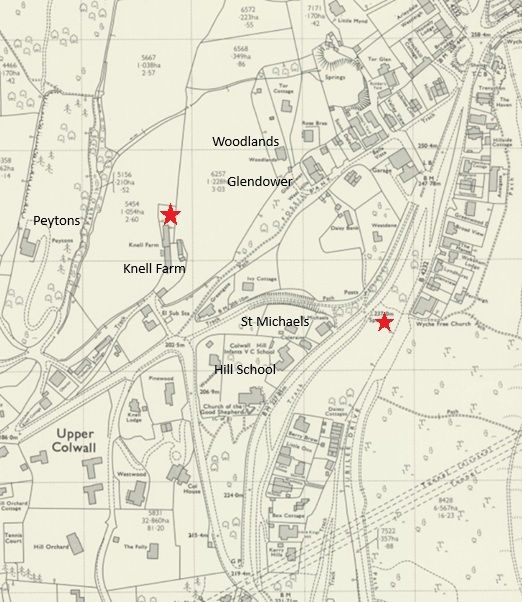
William Powell and his wife were sitting beside their fire in Knell Farm House kitchen, resting after a long day during which they had at first spent milking their cows and then delivering milk around the village with their white pony and float. The pony was grazing peacefully on the hillside just above their farm buildings.
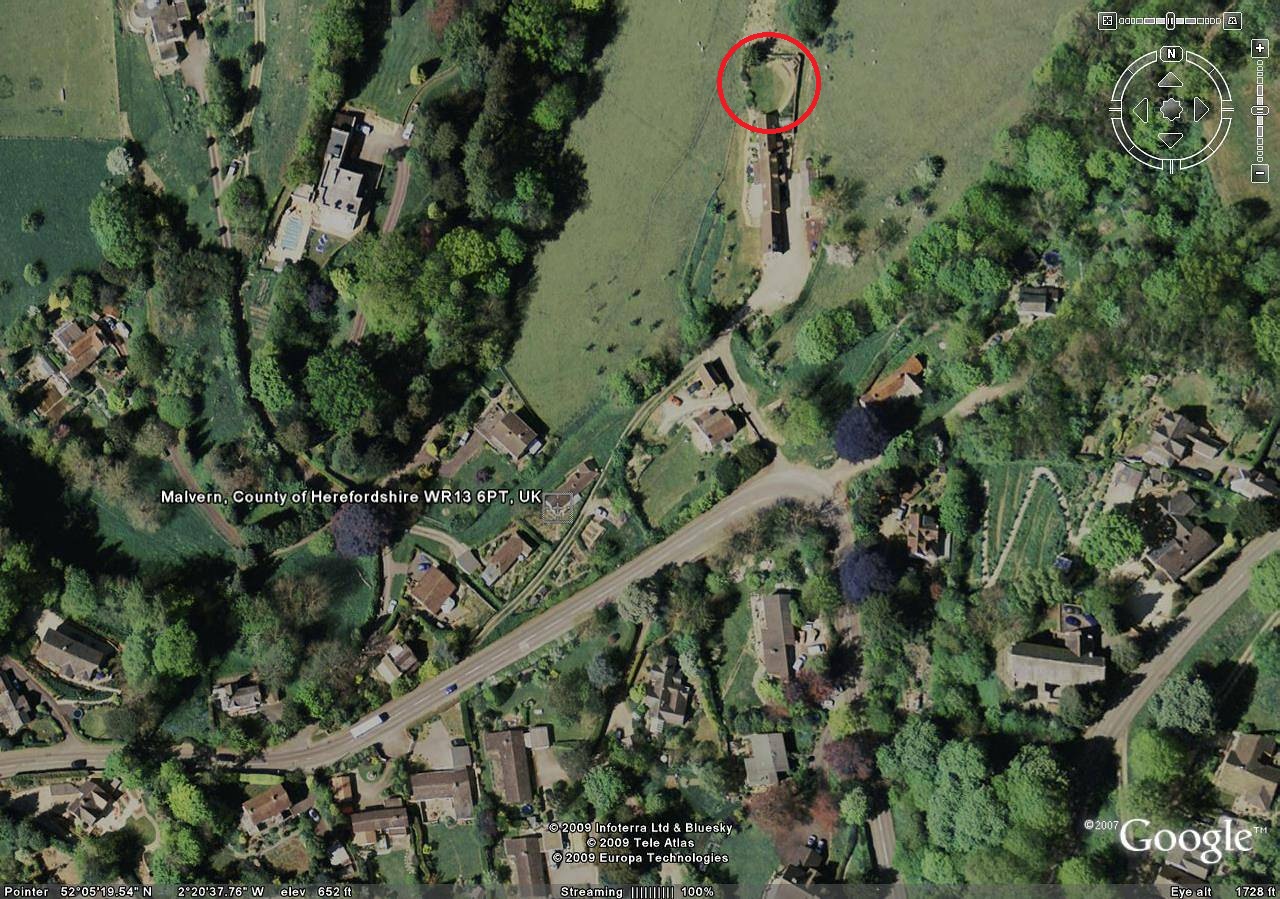
The stillness of the night was suddenly shattered by two massive explosions, one after the other, as a ‘stick’ of probably 500 lb. bombs, jettisoned from an enemy aircraft, which was heading back to Europe down the Bristol Channel and climbing to fly over the hills, fell on the village. One fell harmlessly in a field near Hoe Court, but a second exploded on the hillside above Knell farm, the crater visible to this day, killing the Powell’s white pony instantly. Nearby houses were badly damaged, roofs and tiles blown off, windows were shattered, curtains shredded. The pony lay dead in a badly mutilated state just 10 yards from one of the craters. The fire unit swiftly put out an incendiary bomb, which was spotted burning on a roof.
In Knell Farm plaster fell from the ceiling, giving William Powell superficial head injuries and thus becoming Colwall’s first, but luckily minor, casualty of the war. He and his wife, both badly shocked, went to the cellar and remained there for a while before going outside to inspect the damage.
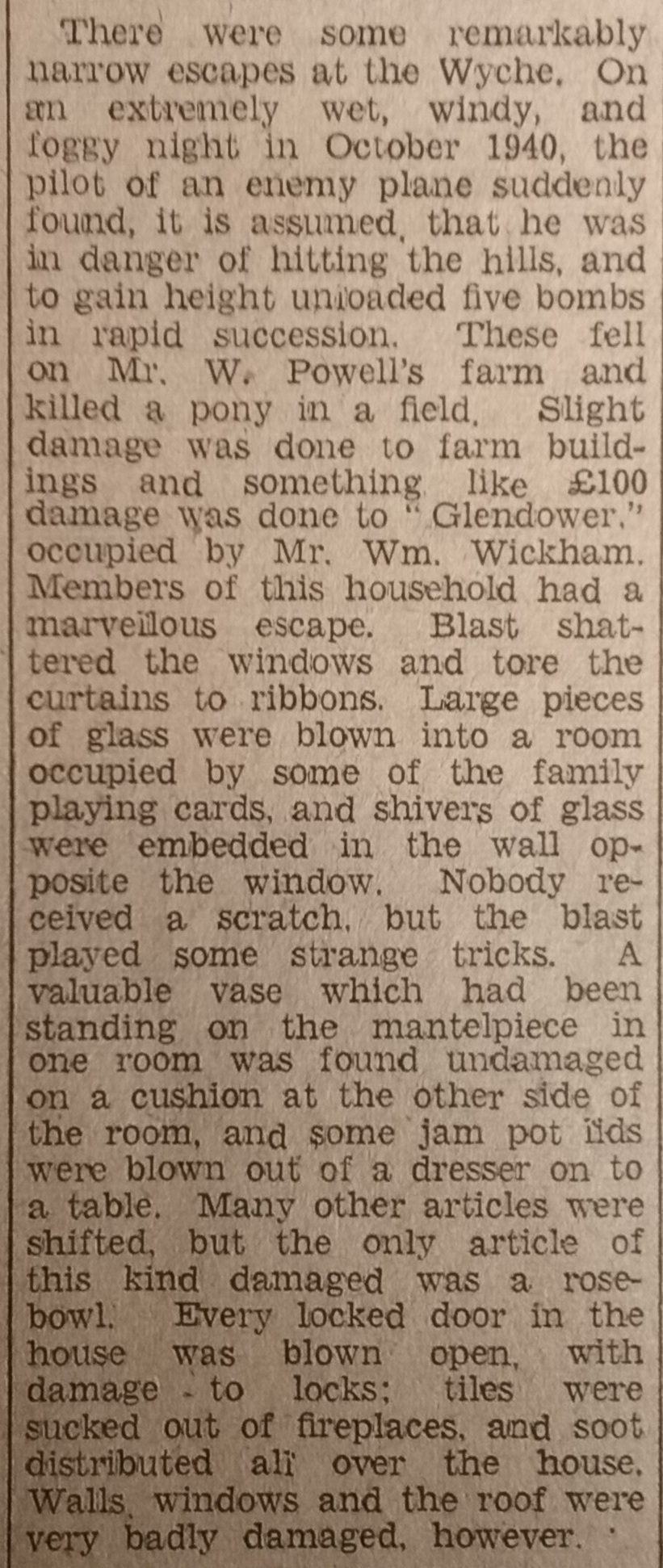
Mr. and Mrs. Allen who lived at the Woodlands noticed the electic light begin to swing, then the house shuddered and the whole of the roof lifted and dropped causing the ceiling to fall in on them. Most of the doors were blown out and windows shattered. In some rooms the glass was blown inwards and penetrated the furniture and walls. There was soot all over the house. Both Mr. and Mrs. Allen were unhurt save for a slight cut on Mr. Allen's head. Their parrot never got over the shock and died soon afterwards.
At nearby Peytons, whose windows had been shattered in the blast, Anne Hill, then a young girl, was evacuated to Barton Court at the far end of the village where she spent the remainder of the night with her school friend Elizabeth Bright. The house worst damaged was ‘Glendower’, where the young William Wickham and his family had their locked doors blasted open and windows blown in, shredding the curtains and embedding slithers of glass in the back of their sitting room.
PC Charlie Moody was swiftly on the scene. Just then however a warden reported to him that there was an unexploded bomb, its fins still clearly visible, buried in the bank between the Hill School and the Free Church in Upper Colwall, near Willow Spring. They quickly set about evacuating the nearby houses on Jubilee Drive and Walwyn road. Ray Dally and Henry Barnett, walking home from a night out in Malvern in the heavy rain like two drowned rats, were quickly sent on their way. It was just as well they were as a short time later the bomb exploded with a terrific roar. Pieces of bomb and stones came down in a shower over a wide area but the damage done was surprisingly small and nobody was hurt.
The nearest residence, St Michael's guesthouse, suffered most and the roof had to be removed the next morning. It was unfortunate that an evacuee from London had just arrived there the day before. The two local churches received minor damage but the Hill School was more seriously damaged. The head master arrived in the morning and on the advice of the Rector, who inspected the damage, was forced to close the school until the 4th November, when it was partially reopened.
The village was scarred but undaunted and a collection was made to enable Mr. Powell to buy a new pony. Life returned to normal and on the following Saturday Cissie Orgee, daughter of the Landlord of the Yew Tree Inn, was married in St James wearing a navy coat trimmed with squirrel fur, whilst eggs were on sale in the village for 3/7p dozen and rabbits (unskinned) were fetching 9p/lb.
Acknowledgements
Nicholas Neve recorded his thanks to Anne Burrows, Stan Dally, David Hodgson, Ann James, Elizabeth Lloyd, Michael Milne, Roy Moody and Simon Williams for contacting him and supplying much of the material.
References
Article based on piece written by Nicholas Neve - CVS Archives M9
Malvern Gazette - 12th May and 2nd June 1945
Hereford Times and the Ledbury Reporter archives.